





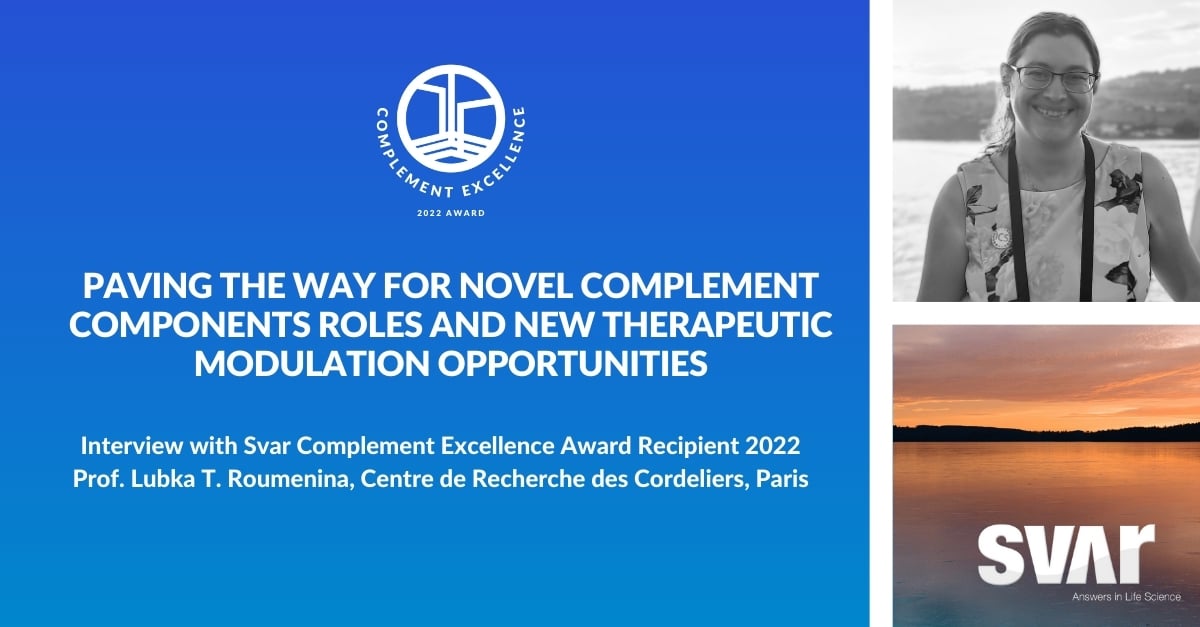

Paving the Way for Novel Complement Components Roles and New Therapeutic Modulation Opportunities
An interview with Svar Complement Excellence Award recipient 2022, Prof. Lubka T. Roumenina, Deputy Director of the Inflammation, Complement, and Cancer team at the Centre de Recherche des Cordeliers in Paris.
Prof. Lubka T. Roumenina is, in her own words, a passionate complementologist. She started studying the complement system at the beginning of her undergraduate studies at the Universi of Sofia in Bulgaria, focusing on the biochemical and biophysical aspects of the system. She continued to more functional approaches in France, where she now is the deputy director of the Inflammation, Complement, and Cancer team at the Centre de Recherche des Cordeliers in Paris.
She is one of the recipients of the 2022 Svar Complement Excellence Award, awarded for her outstanding work in the field of the Complement system and its implications in atypical hemolytic uremic syndrome, sickle cell disease, rhabdomyolysis-associated acute kidney injury, and clear cell renal carcinoma.
“This is a great way of supporting the complement research and raising awareness of the complement-mediated disease. A great recognition of the complement field, the work of my team, my students, and the support of my mentors. This award allows the exploration of innovative ideas and supports the discoveries in the complement field.”
The Complement System: More than defense
The complement system is an integral part of the innate immune system and serves as part of the first line of defense against pathogens. The complement cascade responds to pathogens through a coordinated sequential cascade leading to the clearance of foreign or damaged cells; for that, it needs to be able to recognize what is foreign or dangerous, label it so that it can be identified, and discard it by specialized immune cells.
“For some, the complement is a boring system, for which everything is known, because it has been studied for a long time. Our research has shown that the complement system sits at the basis of pathological processes in diseases that were not considered complement-mediated.”
How this molecular domino initiates depends highly on the nature of the initial trigger. Historically, three ways of activation have been described; the Classical, the Alternative, and the Lectin pathway.
The activation of these three individual pathways converges into one central pathway. The central pathway ends in forming a complex that induces the breaking of pathogens or damaged cells by forming pores in their membrane. The complement cascade activation amplifies the inflammatory reaction and immune response through inflammatory molecules and effectors.
“Additionally, we have described new intracellular functions of the complement proteins regulating physiological processes that have never been considered before. Hence, the complement system role is even broader, and its functions are implicated far beyond what we know.”
Regulation of complement activation at the center of therapeutic approaches
In certain hemolytic diseases (atypical hemolytic uremic syndrome, sickle cell disease), the breaking of erythrocytes causes the release of hemoglobin and heme molecules into the plasma. Myoglobin and heme are also released in case of muscle injury. Extracellular heme has strong proinflammatory potential and activates the immune cells.
Prof. Roumenina’s work has shown that extracellular heme activates the complement cascade promoting inflammation, amplifying endothelial injury, and leading to organ damage. Her work has placed the complement system in the center of the pathological processes of heme-mediated diseases.
Her findings, and others, highlight the potential role of heme scavenging and complement inhibition, representing promising therapeutic options in these conditions.
Today, the first sickle cell disease patient has been successfully treated with a complement inhibitor, and a clinical trial is ongoing.
“I see the possibility of complement-targeted therapeutic strategies in other indications. It is exciting that the findings in Sickle-cell disease open the door to exploring the inhibition or regulation of the complement cascade in different diseases where the complement might be implicated.”
Exploring the unexpected
When studying the complement activation in tumors, she saw indications of the intracellular presence of complement proteins, which was unexpected. These intracellular complement proteins could have non-canonical functions proteins could have non-canonical functions in tumor cells, modulating fundamental processes such as transcription, proliferation, and survival. This is an entirely new field where Prof. Roumenina’s work has put some foundational ground.
“The most interesting is not what you expect, but what you discover in the process, and to have an approach without an established idea, to go for the unexpected, that’s when you can see the full picture.”
Therapeutic approaches targeting the right cell, at the right time, to the right patients
Prof. Roumenina’s research has also highlighted the context-dependent roles of complement in cancer. She has proposed a classification of cancers based on the prognostic impact of the complement system, where the expression of specific complement genes involved in the classical and alternative pathways is associated with differential prognoses—demonstrating that in renal cancer, the over expression of complement genes will confer poor prognosis. Furthermore, the new intracellular function for complement proteins opens a new field to explore the intracellular, non-canonical roles of complement in cancer and the possibility of new context-dependent complement targets.
“Understanding complement action in different tumoral microenvironments fosters the development of innovative therapeutic strategies. Either overactivated the complement cascade to have a massive cell killing or may want to inhibit the chronic complement-mediated inflammation or modulate the immune microenvironment to prevent immunosuppression. All these could be therapeutic strategies, but extensive research is needed to understand the relevance and mechanisms.”
Canonical complement proteins and intracellular ones could potentially be used as biomarkers, allowing for a more specific treatment that might involve regulation of the complement.
“There is a potential of complement proteins to be good biomarkers to stratify patients, either non-invasive in biofluids or intratumorally in the moment of surgery. These biomarkers could predict the outcome of the patient and response to therapy. But much more work is needed it.”
The potential non-canonical functions of intracellular complement proteins it is a new an effervescent field. New research opportunities in terms of their structure and function in the complement field is foreseen and foster the development of new therapeutic targets and strategies.
Read more about Prof. Roumenina’s work:
Selected References
Merle NS et al., 2018. Intravascular hemolysis activates complement via cell-free heme and heme-loaded microvesicles. JCI Insight. doi: 10.1172/jci.insight.96910. PMID: 29925688.
Boudhabhay I et al., 2021 Complement activation is a crucial driver of acute kidney injury in rhabdomyolysis. Kidney Int. doi: 10.1016/j.kint.2020.09.033. PMID: 33137339.
Daugan MV et al., 2021 Intracellular Factor H Drives Tumor Progression Independently of the Complement Cascade. Cancer Immunol Res. doi: 10.1158/2326-6066 PMID: 34039652.
Roumenina LT et al., 2019 Context-dependent roles of complement
in cancer. Nat Rev Cancer. doi:10.1038/s41568-019-0210-0.
PMID: 31666715.
About Svar Complement Excellence Award
The Svar Complement Excellence Award is handed out annually to individuals that have made great contributions to the complement field.
The awards are intended as grants for two recipients, each worth €20.000. In 2022 the prize was handed out during the European Meeting on Complement in Human Diseases (EMCHD), in collaboration with the complement community.
At Svar, we are complementing life science
We harness years of experience and deep specialist knowledge in innate immunity, the complement system, and its intricate connections. With synergetic platforms, Svar delivers tailored solutions spanning immunoassay development, cell engineering, and contract research services that address our customer’s assessment and testing needs.
The synergy created by our integrated suite of offerings provides customers with a comprehensive approach that not only enhances efficiency but also fosters innovation, enabling seamless transitions from discovery to clinical application.