





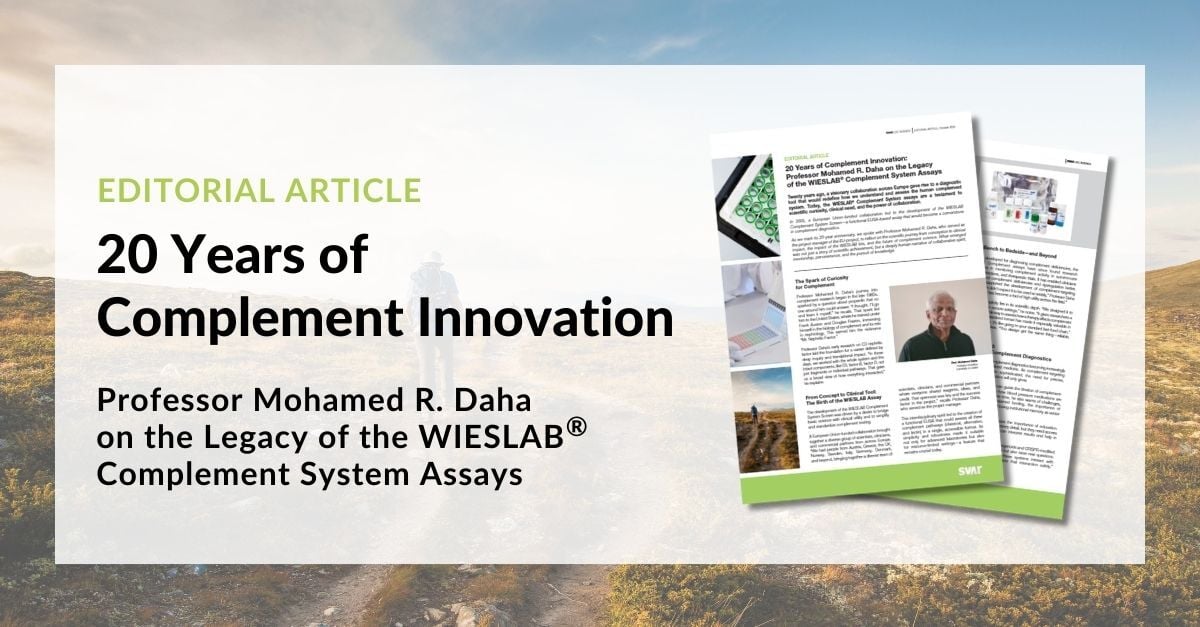

Twenty years ago, a visionary collaboration across Europe gave rise to a diagnostic
tool that would redefine how we understand and assess the human complement
system. Today, the WIESLAB® Complement System assays are a testament to
scientific curiosity, clinical need, and the power of collaboration.
In 2005, a European Union-funded collaboration led to the development of the WIESLAB
Complement System Screen—a functional ELISA-based assay that would become a cornerstone in complement diagnostics.
As we mark its 20-year anniversary, we spoke with Professor Mohamed R. Daha, who served as the project manager of the EU-project, to reflect on the scientific journey from conception to clinical impact, the impact of the WIESLAB kits, and the future of complement science. What emerged was not just a story of scientific achievement, but a deeply human narrative of collaborative spirit, mentorship, perseverance, and the pursuit of knowledge.
The Spark of Curiosity for Complement
Professor Mohamed R. Daha’s journey into complement research began in the late 1960s, sparked by a question about properdin that no one around him could answer. “I thought, I’ll go and learn it myself,” he recalls. That spark led him to the United States, where he trained under Frank Austen and Douglas Fearon, immersing himself in the biology of complement and its role in nephrology. This earned him the nickname “Mr. Nephritic Factor.”
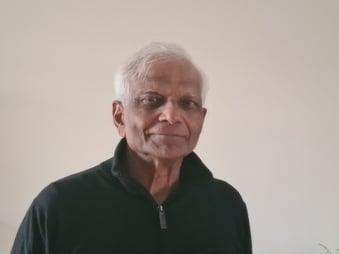 Professor Daha’s early research on C3 nephritic factor laid the foundation for a career defined by deep inquiry and translational impact. “In those days, we worked with the whole system and the intact components, like C3, factor B, factor D, not just fragments or individual pathways. That gave us a broad view of how everything interacted,” he explains.
From Concept to Clinical Tool: The Birth of the WIESLAB Assay
The development of the WIESLAB Complement System Screen was driven by a desire to bridge basic science with clinical utility and to simplify and standardize complement testing.
A European Union–funded collaboration brought together a diverse group of scientists, clinicians, and commercial partners from across Europe. “We had people from Austria, Greece, the UK, Norway, Sweden, Italy, Germany, Denmark, and beyond, bringing together a diverse team of scientists, clinicians, and commercial partners where everyone shared reagents, ideas, and credit. That openness was key and the success factor in the project,” recalls Professor Daha, who served as the project manager.
This interdisciplinary spirit led to the creation of a functional ELISA that could assess all three complement pathways (classical, alternative, and lectin) in a single, accessible format. Its simplicity and robustness made it suitable not only for advanced laboratories but also for resource-limited settings—a feature that remains crucial today.
Overcoming Challenges & Driving Innovation
“The main challenge wasn’t just developing the assay,” Professor Daha explains, “but ensuring it could be implemented in clinical medicine in a way that made sense to physicians.” The team’s goal was to develop an assay that could provide meaningful insights for clinicians: simple, reliable, and interpretable results that could guide patient care. “Our meetings were filled with scientific debate, but always ended with the question: ‘How do we measure this in the simplest, most effective way?’”
One of the biggest hurdles was ensuring the assay’s clinical relevance. “We needed well-defined patient cohorts and clear clinical expectations,” he explains. “Clinicians don’t need exact values; they need to know if something is present, absent, or abnormal.”
The team also faced technical challenges in developing a reliable assay for the lectin pathway, which at the time lacked robust tools. “That was a major part of the research,” he says. “And we’re still working on expanding it to include ficolins and other components.”
The assay’s design was intentionally straightforward. “We wanted something that clinicians could be able to look at the results and immediately understand what was happening; something that could show, at a glance, whether a pathway was functioning,” says Professor Daha.
The assay was designed to assess the classical, alternative, and lectin pathways in a single, easy-to-use ELISA format. “The assay readout is simple and intuitive, and you don’t even need a complicated machine to get an inkling about the results. You could simply judge it by eye,” Professor Daha adds. This clarity, combined with robust performance, has since helped the assay gain traction in both research and clinical settings.
Designed for Impact: Features & Benefits of the WIESLAB® Assays
The WIESLAB Complement System Assays have become a cornerstone in both diagnostics and research.
Their success lies in their thoughtful design:
- Pathway-specific analysis:
Simultaneous assessment of classical, alternative, and lectin pathways. - Standardized ELISA format:
Ensures reproducibility across labs and studies. - Broad utility:
Used to study autoimmune diseases, infections, complement deficiencies, and in therapeutic development.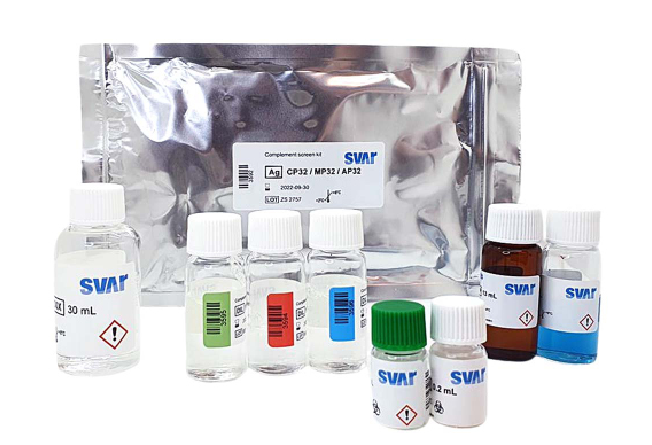
From Bench to Bedside—and Beyond
Originally developed for diagnosing complement deficiencies, the WIESLAB Complement assays have since found research applications in monitoring complement activity in autoimmune diseases, infections, and therapeutic trials. It has enabled clinicians to understand complement deficiencies and dysregulation better, as well as supported the development of complement-targeting therapies. “We didn’t expect it to be used so widely,” Professor Daha admits. “But it has become a tool of high utility across the field.”
“We wanted something that clinicians could be able to look at the results and immediately understand what was happening; something that could show, at a glance, whether a pathway was functioning.”
The assay’s simplicity lies in its scientific depth. “We designed it to be usable even in remote settings,” he notes. “It gives researchers a stable, reproducible way to assess how a therapy affects complement function. Its standardized format has made it especially valuable in drug development. It’s like going to your standard fast-food chain,” Professor Daha jokes. “You always get the same thing—reliable, consistent results.”
Looking Ahead: The Future of Complement Diagnostics
Professor Daha sees complement diagnostics becoming increasingly integrated into personalized medicine. As complement-targeting therapies become more sophisticated, the need for precise, pathway-specific diagnostics will only grow.
He envisions assays that can guide the titration of complement-inhibiting drugs, much like how blood pressure medications are adjusted today. At the same time, he also warns of challenges, such as the need for sustained funding, the importance of collaboration, and the risk of losing institutional memory as senior scientists retire.
Professor Daha also emphasizes the importance of education. “Clinicians don’t need to know every detail, but they need access to clinical immunologists who can interpret results and help in guiding treatment.” Emerging technologies, such as organoids and CRISPR-modified models, offer exciting possibilities but also raise new questions. “We need to understand how these systems interact with complement and how to modulate that interaction safely,” Professor Daha cautions.
A Legacy of Mentorship & Collaboration
For Professor Daha, the legacy of the Wieslab project is as much about people as it is about science. Beyond his scientific achievements, he remains deeply committed to mentoring the next generation. “As a senior scientist, it’s your duty to help young people,” he says. He continues to advise PhD students, review grants, and foster international collaborations.
His advice to early-career researchers? “Find a good mentor. Stick with one problem. Don’t chase trends. Go deep. And maybe most important: be nice to people!” It’s a philosophy that has guided his own career, from early work on C3 nephritic factor to contributions for deeper understanding of complement activation in age-related macular degeneration.
Reflections on a Remarkable Journey
When asked what he’s most proud of, Professor Daha points to the practical impact of his work. “We took something from the lab and made it useful for patients. That’s the real reward.”
And what still excites him? “The complexity of complement. It’s like a sponge ball: press one part and something happens somewhere else. There’s always more to discover.”
A Call for Continued Collaboration
Reflecting on the past 20 years, Professor Daha underscores that the most enduring lesson from the Wieslab project is the importance of openness and shared purpose. “In our consortium, everyone shared reagents, ideas, and credit without any problem,” he recalls. “That’s rare today, but it’s essential if we want to keep advancing.” In an era where proprietary barriers often hinder progress, his message is clear: science advances when knowledge is shared.
Promoting Excellence in Complement Research
The success of the Wieslab project has inspired a few follow-up initiatives. The consortium continued to explore new clinical and research applications for the WIESLAB assay through the “Search for Applications for WIESLAB Complement System Screen” (SAW) initiative.
In 2022, Svar Life Science, in collaboration with the consortium behind the WIESLAB Complement assays, established the Svar Complement Excellence Award. This award recognizes remarkable international contributions by researchers and physicians in the
field of complement, celebrates the legacy of excellence in complement research, and stimulates future innovation.
“In our consortium, everyone shared reagents, ideas, and credit without any problem. That’s rare today, but it’s essential if we want to keep advancing.”
The Complement Excellence Award also helps fund important research that deepens our understanding of this essential part of the immune system. Awarded annually to two recipients, it not only honors past achievements but also fuels the next generation of discoveries.
As we celebrate two decades of the WIESLAB Complement System assays, we honor not just a diagnostic tool but a model of scientific collaboration, mentorship, and innovation. We thank Professor Daha and all those who contributed to this remarkable journey and look forward to the discoveries yet to come.
The journey continues. The future of complement science is in good hands.