







Scientists have long dreamed of curing patients suffering from inherited diseases by making changes to defective genes. A little over three years ago, the FDA approved the first directly administered gene therapy drug for a disease caused by a single defective gene. This product is now used to treat patients suffering from a rare inherited retinal disease that previously had no effective treatment. Following the success story of this first gene therapy product, the interest in gene therapy is increasing exponentially with thousands of clinical trials ongoing or completed.
Although the principle of gene therapy may be straightforward, the complexity and scope of the analytical methods associated with this technology are not. It introduces a number of analytical challenges that are not encountered with conventional biopharmaceutical products. Complex and time-consuming bioassays are needed throughout the study to assess product potency, confirm product identity, identify impurities and test for immunogenicity.
The complexity of gene therapy
The analytical challenges of creating bioassays for gene therapy projects
Recently both the FDA and the EMA have released guidelines to help companies navigate this treacherous landscape, with patient safety being the number one concern. Both agencies have outlined recommendations regarding conducting long-term follow-up (LTFU) in their respective regulatory protocols. These assessments ensure that patients are monitored for delayed adverse events and receive optimal treatment over the long-term, e.g. by monitoring immunogenicity over time.
All companies working with biological drug products are faced with the challenging task of creating a potency assay that properly reflects the mode of action (MoA) of the product. This regulatory requirement is made even more difficult in a gene therapy setting, when the protein under study is created by the host cell using genetic material introduced through a viral vector. An advanced bioassay that can be used to both quantify the protein and confirm its functionality is therefore needed.
Furthermore, monitoring of NAbs – neutralizing antibodies – is especially essential for gene therapies since many of them rely on the use of viral vectors, often adeno associated virus (AAV), to deliver the genetic cargo to the cells of the patient. As AAV is a common virus, the patient may have been subjected to the virus previously and developed immunity, which would render the treatment ineffective. In some estimates, up to half the population carries antibodies against the AAVs commonly used for therapeutic purposes.

“We are seeing a massive increase in the number of requests from pharmaceutical companies for mode of action reflective potency and immunogenicity assays for gene therapy projects,” says Therese Segerstein, Product Manager at Svar Life Science. “A really good solution is the cell-based assay design, both for potency assays as well as a way to detect NAbs.”
Cell-based assays play an important role in drug discovery as they are inexpensive compared to full-scale in vivo animal models, yet often more biologically relevant than ligand-binding assays. Compared to animal models, they are also more reproducible, scalable and can be based on human cells of the relevant type.
“Clients come to us for our long history of designing cleverly engineered assays using the iLite® technology, which can be used in robust assays while still remaining biologically relevant”
Therese Segerstein, Svar Life Science
Advanced Solutions to Address Gene Therapy Challenges
How custom objectives can be solved using reporter gene assays
“Not too long ago, we were contacted by a client that needed assistance in designing a potency assay for a gene therapy project. As we do in any project, we initiated the project by assembling our team of scientists and discussed the objectives of the project with the client” says Segerstein.
“Defining the right objective and expected outcome is key for any development project and is especially important for the success of a gene therapy project, which by nature is very complex.”
For this project, the client was interested in an assay measuring guanylate cyclase (GC) activity, to assess the potency of their gene therapy product. GC is an enzyme found in the retina where it is involved in the visual phototransduction in rods and cones by converting GTP to cGMP. Segerstein notes that “It really is a team effort to come up with a creative solution for a project like this, and our cell-based development team in Paris has vast experience and the know-how needed to take on a challenging project like this.”
The suggested solution was to construct an iLite® reporter-gene assay responsive to cGMP. Since cGMP acts as a second messenger and its concentration correlates to that of GC, it can be used to quantify GC enzyme activity.
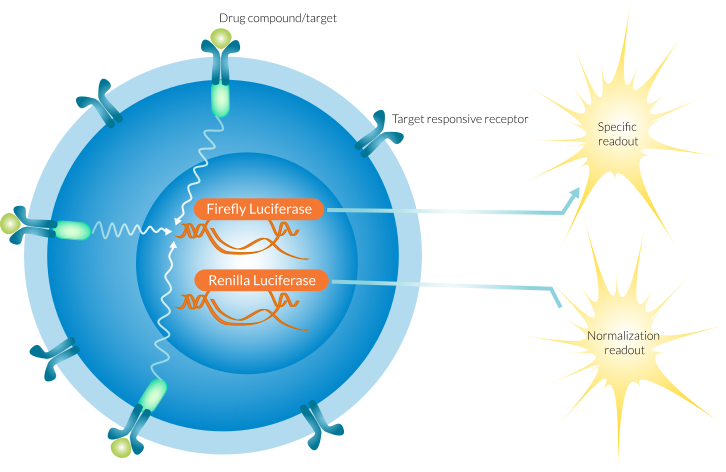
The cell-based assay that was developed has a luciferase reporter gene construct that is regulated by a cGMP-responsive promoter; hence luciferase will be expressed in the presence of cGMP. This correlation between increased cGMP levels and the presence and function of GC makes this a mode of action reflective assay that can be used to assess the potency of the gene therapy drug.
As an added benefit of the iLite technology, these cells also constitutively express a secondary luciferase gene, Renilla luciferase, that can be used for normalization of cell numbers, account for matrix effects and as a general indicator of cell viability.
“This was a complex project where we not only needed to show that the genetic cargo had been delivered, but also that the gene product was functional. Here the cell-based format really comes into its own, since both can be shown in the same assay” says Therese Segerstein, when elaborating further on the development.
“The cell-based format really comes into its own, since both [delivery of genetic cargo and functionality of the gene product] can be shown in the same assay”
In order to create the cell line, cells were transfected with the appropriate vectors in several steps. Clones were selected that were highly responsive to cGMP with no interference from cAMP. But it was equally important to show that the cells were responsive to the cGMP created by the genetically introduced GC enzyme. This was achieved by transient transfection of the cell line with GC DNA (GUCY2D) and ensuring a subsequent cGMP-induced firefly reporter-gene activity.
The iLite® reporter gene system
When a ligand, e.g. your drug candidate, binds to its receptor on the iLite cell surface, a specific intracellular signaling pathway is activated. This triggers the transcription of a specific reporter gene construct coding for luciferase.
When a substrate is added, the luciferase generates light, and the amount of luciferase and thereby the amount and activity of the ligand can then be measured as light emission using a luminometer.
Unique features of the iLite cells
By combining unique features such as a normalization readout and chimeric transcription factors with a highly flexible product format, the iLite technology can help you make the most of your bioassay.
Briefly, the chosen host cell is transfected with target specific genetic constructs and stable clones are produced that carry both an inducible reporter gene (target specific) and a constitutive reporter gene (for normalization) as well as constructs for expression of surface receptors and engineered transcription factors.
Validation & manufacturing
Securing a safe and effective product
Following the first development phase where the described cell line is developed, a master cell bank (MCB) and a working cell bank (WCB) are prepared and characterized, the cells are then transferred from the R&D site in Paris to the manufacturing site in Malmö.
 “Once we receive the cells from Paris, we take over the reins,” says Lone Bovin, Scientific Lead and Senior Scientist at Svar Life Science. “We plan the testing of the new cell line and consider issues like: Which applications of these cells are relevant? What stimulates them? What performance can we expect from them? Which test procedure can document the required functionality?
“Usually, we have preliminary protocols from the Paris site that we expand and adapt” continues Bovin.
Since the manufacturing of the cells can be lengthy, due to different culturing conditions, it is done in parallel with the initial testing efforts. “We typically use three validation batches, says Lone Bovin, one that is made in Paris and two more that are created in Malmö.
The entire manufacturing process is performed according to standard operating procedures and each batch has its own diary to ensure that everything is recorded properly.
Extensive validation and performance package
Cell line characterization
An extensive validation and performance package is done on the new cell lines, where the team makes a plan for quality control (QC) testing. Typical parameters such as variances within and between operators and batches are tested to create a broad dataset. QC criteria are set up for a large set of parameters, e.g., cell viability, EC 50 and fold induction and other performance-related factors.
Once the QC criteria are established, each new lot will be analyzed using six vials, from the beginning, middle and end of the manufacturing cycle. For every new lot released, cells are set aside for inclusion in a real-time stability study, to ensure that they are stable for at least three years at -80°C. Furthermore, all data collected is plotted against previous data points to ensure that there is no drift in the signal over time.
Securing assay performance
Assay performance is an important step in the development of any reporter-gene cell line. In this case, the cell line was tested using an AAV5 virus containing GUCY2D and a negative control to ensure that the cells can be infected by the virus, that GC activity can be quantified and that linearity curves for different concentrations can be obtained. In addition, experiments are performed to ensure that the signal is specific, that it can be inhibited and has the potential to be used as a way of screen patients’ blood for the presence of NAbs directed against the gene therapy vector.
Answering to the analytical challenges of Gene Therapy
A fit for purpose cell line
Since gene therapy offers hope for the hundreds of millions of people that live with genetic diseases worldwide, it is important to find tools and analytical solutions that can support this new and exciting field, and that always have the patients’ safety as a top priority.
The process of developing an advanced potency assay for an advanced product, like the reporter-gene assay described above – from the initial contact with the client through development and validation to manufacturing of the finished product – is not without its challenges. The process of designing, constructing, producing and validating a fit-for-purpose potency assay for use in batch release of an AAV-based gene therapy drug showcases the importance of not only defining the right objective and expected outcome, but also the importance of a creative mindset, understanding the complexities of gene therapies and great partnership between client and development partner.
About Svar Life Science
Svar is a Swedish life science company that invents, develops and applies the best assay technology for drug development and clinical diagnostics with the goal to deliver new solutions tailored to customer requirements.
Svar Life Science has extensive experience in developing iLite reporter-gene assays and can create cell-based assays for almost any target. Using these assays, we help pharmaceutical companies create safe and effective treatments and help advance drug discovery.
Would you like to book one of our experts for a free consultation?
Our scientific experts are here and ready to help - a great opportunity to discuss your specific projects!