





-1.jpg?width=1200)

Article originally published by Select Science (selectscience.net)
In the article, experts from Svar Life Science, explain the process behind the development of the iLite® CDC platform. Explore the significance of an assay that goes beyond interaction.
In the dynamic landscape of immune-oncology, assessing Complement-Dependent Cytotoxicity (CDC) is crucial, yet existing tools face limitations, failing to reveal true cell lysis. Svar R&D teams in Paris and Malmö combined their expertise to address this need. This collaboration between cell-engineering and analytical experts resulted in a robust cell-based assay that truly shows cell lysis. The new development has been met with positive feedback from customers who have tested the platform.
Read this exclusive interview to learn about this innovative tool’s molecular and analytical nuances.
The CDC Assay: A Crucial Element in Drug Development
The iLite CDC cell-based assay platform emerges as an indispensable tool in drug development, enabling the evaluation of potential treatments such as monoclonal antibodies (mAbs) and complement therapeutics. Monoclonal antibodies have the potential to activate various Fc-dependent immune effector mechanisms, including Complement-Dependent-Cytotoxicity (CDC). CDC is a powerful innate defense mechanism that is highly effective in controlling and eliminating malignant cells. Currently, different strategies are being developed to enhance antibody Fc activities and improve CDC activity for different indications and biosimilar mAbs. Thus screening for this activity has become essential when developing antibody-based drugs.
The Wonders of Molecular Biology Behind a Truly Reflective Mode of Action Assay
The CDC cells are a key component of the iLite CDC customizable platform, which monitors cell lysis upon complement activation. What sets it apart is the ingenious engineering of the luciferase gene. Its unique construction ensures that the luciferase remains trapped in the nucleus until cell lysis occurs, offering a distinguishing feature from current CDC assays, as the cell lysis is done by the action of the complement system.
Notably, the luciferase in this CDC assay is stable upon cell lysis, enabling the use of cost-effective reagents for the luminescent reaction and providing economic advantages to the users, as M.Sc. Ferrando explains.
“It is great to realize the potential of the cells to become a platform and apply the engineering of the luciferase gene in different cells for different assays. For us, the project is not done. We are just at the beginning to see what the platform can achieve.”M. Sc. Rosa Ferrando-Miguel
Research Engineer, Svar Life Science Paris

The Journey of Developing a Robust CDC Assay Platform
The journey of developing the customizable CDC platform was not without its challenges, and overcoming those is a great scientific reward – explains M. Sc. Ferrando. Designing the luciferase to remain inside the nucleus demanded extensive molecular biology work, while introducing it to the cell line posed difficulties as not all cell lines are easily modifiable.
Overcoming these hurdles, the team successfully constructed a plasmid to modify and express different surface antigens. Additionally, optimizing the freezing protocol for assay-ready cell format proved to be intricate but resulted in a robust cell-based assay. “Developed entirely in-house, these assays offer customization capabilities, allowing for the modification of the plasmid to express any surface markers; making it a versatile platform” explains M. Sc. Ferrando.
The assay has been optimized for cell type and density, ensuring ease of use and reproducibility. Each single vial contains fix number of cells in a frozen stage that yield robust and consistent results, eliminating the need for cell counting.
“We are thrilled when we receive feedback that says, ‘We are happy with the cells!’ It is satisfying to see that our products are the best in class when evaluated by our customers”Ph.D. Selvi Celik,
Scientist, Svar Life Science Malmö

Bridging the Gap from Innovation to Product
To transform the CDC cells into a product, the cell-based team in Malmö, led by Ph.D. Frier Bovin and Ph.D. Celik were responsible for the tech transfer. This process involves live training, risk assessment, cultivation, and establishment of stimulation or inhibition protocol assays to prepare for the material undergoing QC testing.
During this process, there is further optimization or fine-tuning of the protocol; for example, how the cells are handled is extremely important, explained Ph.D. Celik. The team has written a detailed application note where the end customer can learn details from the collaborative efforts between the Paris and Malmö teams, ensuring seamless integration into diverse R&D settings. “We aim to provide users with the knowledge and tips needed for stellar results,” – mentioned Ph.D. Frier Bovin.
Principle of the iLite CDC Assay Platform
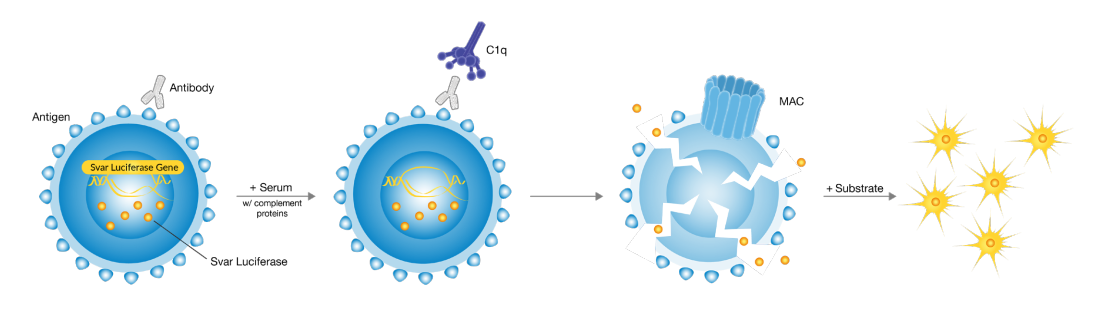
The CDC assay platform consists of a CD20(+) SvarLuc cell line that has been engineered to constitutively express Svar Luciferase (SvarLuc). SvarLuc has been engineered to be kept in the nucleus. Only upon the complement-dependent disintegration of the cells, the luciferase is released into the medium where in contact with its substrate can be detected by a luminometer.
Setting Benchmarks for Reproducibility and Success
Assessing the performance of Svar assays involves a meticulous evaluation of the R&D team in Malmö. For the CDC assay, this process included evaluating the potency assay performance, validation of batches, meticulous documentation, lot-to-lot, day-to-day, and operator variation. The QC testing benchmarks are determined before the test and performed for each cell batch.
“It’s good to know that I am part of a group that does something beneficial for our customers and for those they work for. In our case, we are in the preclinical and research stage, and it’s great to see that our product covers something requested and valued. At the end of the day, we are enabling research that will help patients, which is our ultimate goal.”
Ph.D. Lone Frier Bovin
Scientific Lead & Senior Scientist, Svar Life Science Malmö
The team paid extra attention to the assay’s sensitivity and the fold induction to ascertain the efficacy. As part of the characterization of the cell line, stability testing is conducted at 3-month intervals to determine the stability of the cells. This determines the products’ shelf-life, and the expiry date is provided in the certificate of analysis.
As the project continues to unfold, with the customization capabilities, the team envisions the platform’s potential expanding, ushering in a new era in drug development.
THE iLite CDC Platform is Highly Flexible with Endless Customization Possibilities
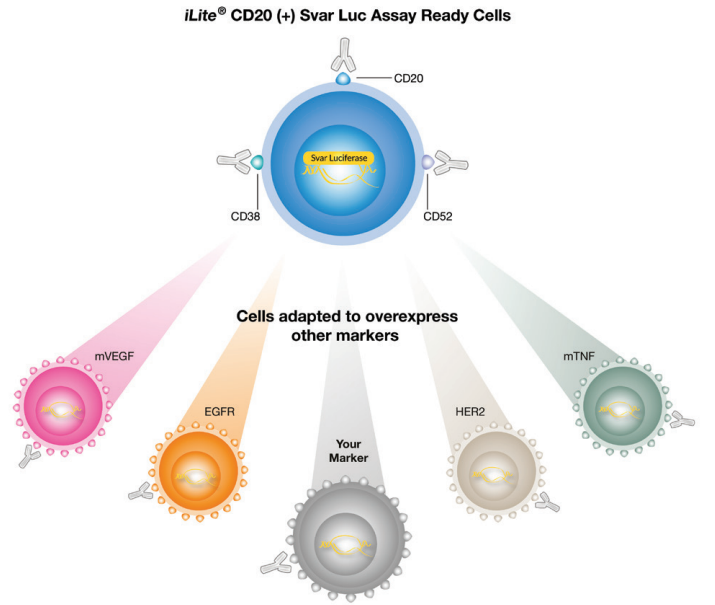
At Svar, we are proud to have completely developed the iLite CDC assay platform in-house. With our highly adaptable iLite technology, it’s easy to customize the platform to include a range of surface antigens, making sure it caters to diverse research needs.
The iLite CD20 (+) cell line also expresses CD38 and CD52 on the cell surface. Our CDC bioassays are unmatched in versatility, allowing you to target various membrane-bound cytokines like mTNF or mVEGF, as well as HER2 and EGFR or the marker you need. With this level of customization, you can be sure that our CDC platform will meet your research needs.
Trust by Scientists Proven by Results
The iLite Complement-Dependent Cytotoxicity (CDC) Bioassay has received highly positive feedback from various laboratories where it has been implemented.
This platform offers a comprehensive solution to evaluate antibody-mediated CDC with unparalleled accuracy and efficiency. By providing scientists with robust tools for drug development and immunological research, these assays could pave the way for groundbreaking discoveries and transformative treatments in diverse disease contexts.
“It is really exciting to be part of this challenging project, and to see now as a final product, also to go out and receive feedback from users that the cells are performing great and doing what they are supposed to do”M. Sc. Emilie Gobbo
Research Engineer, Svar Life Science Paris

Overall, the iLite CDC Bioassay is a promising tool that can help accelerate the progress of medical research and bring us closer to developing effective treatments for various diseases. For further information, please contact us to explore the full potential of our CDC bioassays in advancing your research goals.