




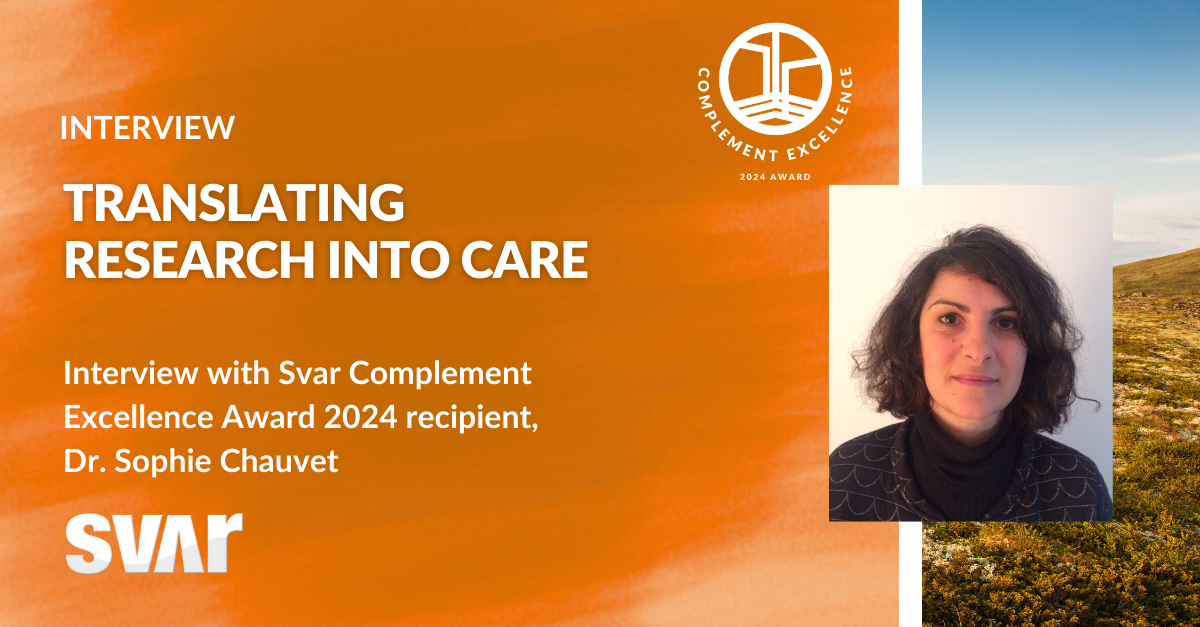

Translating Research into Care - Exploring Complement with Dr Sophie Chauvet
An interview with Svar Complement Excellence Award recipient 2024.
Earlier this fall, Dr. Sophie Chauvet was awarded the 2024 Svar Complement Excellence Award. We caught up with her at the prize ceremony at the European Meeting on Complement in Human Diseases (EMCHD), in Lübeck, Germany.
Here, she shared her journey and insights into the fascinating world of the complement system, a crucial part of our immune response. Her story is one of dedication, discovery, and a relentless pursuit of understanding complex diseases.
A Journey into Complement Research
Dr. Chauvet’s interest in the complement system began during her medical school years. “I started to do research on the complement system during medical school, during my master’s in research,” she recalls. Her collaboration with Dr. Veronique Fremeaux-Bacchi on C3 glomerulopathy (C3G) marked the beginning of her deep dive into this field. “She identified the first mutation of C3 in a family of patients from my town, and I decided to go to the lab to study the functional characterization of this mutation.”
“When I started, we didn’t have the tools that we have today. We used older technologies such as hemolytic assays.”
Evolution of Understanding
Over the years, Dr. Chauvet’s understanding of the complement system has evolved significantly. “When I started, we didn’t have the tools that we have today. We used older technologies such as hemolytic assays”, she explains. This shift has allowed her to rediscover and reinterpret results with modern approaches, providing a fresh perspective on her findings.
Focus on C3G and aHUS
Dr. Chauvet’s research primarily focuses on C3G and atypical Hemolytic Uremic Syndrome (aHUS). Both diseases are prototypes of complement-mediated diseases but differ in their origins. “aHUS is more genetic, and C3G is more acquired,” she notes. While aHUS patients often have genetic abnormalities of complement proteins, C3G patients typically have autoantibodies targeting complement proteins.
Her translational research activities are based on a close and longstanding collaboration with the immunology laboratory of Hôpital Européen Georges-Pompidou, a reference center for complement exploration, and around forty nephrology centers in France. This extensive network has enabled the establishment of substantial patient cohorts, making her department a national reference center for the care of complement-mediated kidney diseases. “I am working on all aspects of these two pathologies: epidemiology in France, correlation between phenotype and identified complement abnormalities, the search for new diagnostic and prognostic biomarkers, as well as the functional characterization of acquired or genetic complement abnormalities identified in these two pathologies,” she explains.
“aHUS patients often have genetic abnormalities of complement proteins, C3G patients typically have autoantibodies targeting complement proteins.”
Dr. Chauvet and her colleagues have found that a great majority of children with acute postinfectious glomerulonephritis (GN) – a leading cause of acute nephritis – experienced complement overactivation via the alternative pathway, driven by autoantibodies targeting factor B. Since these antibodies are highly specific for acute postinfectious GN, screening for anti-factor B antibodies could help distinguish it from C3G during the acute phase.
She was the first author in a publication that found that two biomarkers, C3 and sC5b-9, can identify adult patients at higher risk for poor renal outcomes. These biomarkers also correlate with kidney lesions, underscoring the role of complement activation in kidney pathology and prognosis. These results are important since predicting outcomes at disease onset has been notoriously challenging in C3G.
“We are trying to identify some cell populations that could be associated with the phenotype and the prognosis of the disease.”
Challenges and Future Directions
One of the significant challenges in Dr. Chauvet’s field is finding effective treatments. “For C3G, there’s a crucial aspect of the disease that remains elusive, and uncovering the underlying mechanisms is essential,” she admits. Despite the complexities, she remains hopeful about potential treatments, such as bispecific antibodies targeting both C3 and factor H.
Currently, Dr. Chauvet is exploring the consequences of complement overactivation within kidney-related conditions. “We are trying to identify some cell populations that could be associated with the phenotype and the prognosis of the disease,” she says, highlighting the importance of translational research in her work. Her fundamental research within the French National Institute of Health and Medical Research (INSERM) 1138 team focuses on the intra-renal consequences of complement activation, aiming to identify the impact of complement on renal cell homeostasis.
“It’s a huge recognition to be selected by the scientific committee.”
Recognition and Impact
Receiving the Svar Complement Excellence Award has been a significant recognition for Dr. Chauvet. This prestigious award acknowledges her outstanding contributions to the complement field. “It’s a huge recognition to be selected by the scientific committee,” she says. This award underscores her contributions to the complement community and her role as a clinician and researcher.
Future Projects
When asked about the Excellence Award funding, Dr. Chauvet is excited about new projects and experiments. “We are doing transcriptomic analysis, genomic analysis, and this money will be used for kidney biopsies and for transcriptomic analysis,” she shares. These efforts aim to further the understanding of complement overactivation and its impact on kidney diseases.
Dr. Chauvet is also part of a national consortium for clinical research on aHUS and has been benefiting from an INSERM interface contract since 2023 to continue her research on complement-mediated kidney diseases.
“The goal is to determine the mechanisms of complement activation and to evaluate the intra-renal consequences in order to identify complement inhibitory molecules for these conditions”
Her objective is to extend the methodology used to understand the role of complement in C3G to other glomerular kidney diseases. She has established collaborations to work on the C5a/C5aR axis in ANCA-associated vasculitis, the role of complement and C5aR in post-infectious glomerulonephritis, and renal involvement associated with monoclonal gammopathies. “The goal is to determine the mechanisms of complement activation and to evaluate the intra-renal consequences in order to identify complement inhibitory molecules for these conditions,” she explains.
Dr. Chauvet’s journey is a testament to the importance of perseverance and innovation in medical research. Her work continues to pave the way for new discoveries and novel treatments in the field of complement-mediated diseases.
Read more about Dr. Sophie Chauvet’s work:
Selected References
Chauvet S et al. Treatment of B-cell disorder improves renal outcome of patients with monoclonal gammopathy-associated C3 glomerulopathy. Blood. 2017. 129(11):1437-1447.
Chauvet S et al. Anti-Factor B Antibodies and Acute Postinfectious GN in Children. J Am Soc Nephrol. 2020. 31(4):829-840.
About the Prize
The Svar Complement Excellence Award is handed out annually to individuals that have made great contributions to the complement field.
The awards are intended as grants for two recipients, each worth €20.000. In 2024 the prize was handed out during the 19th European Meeting on Complement in Human Diseases (EMCHD) in Lübeck, Germany in collaboration with the complement community.