





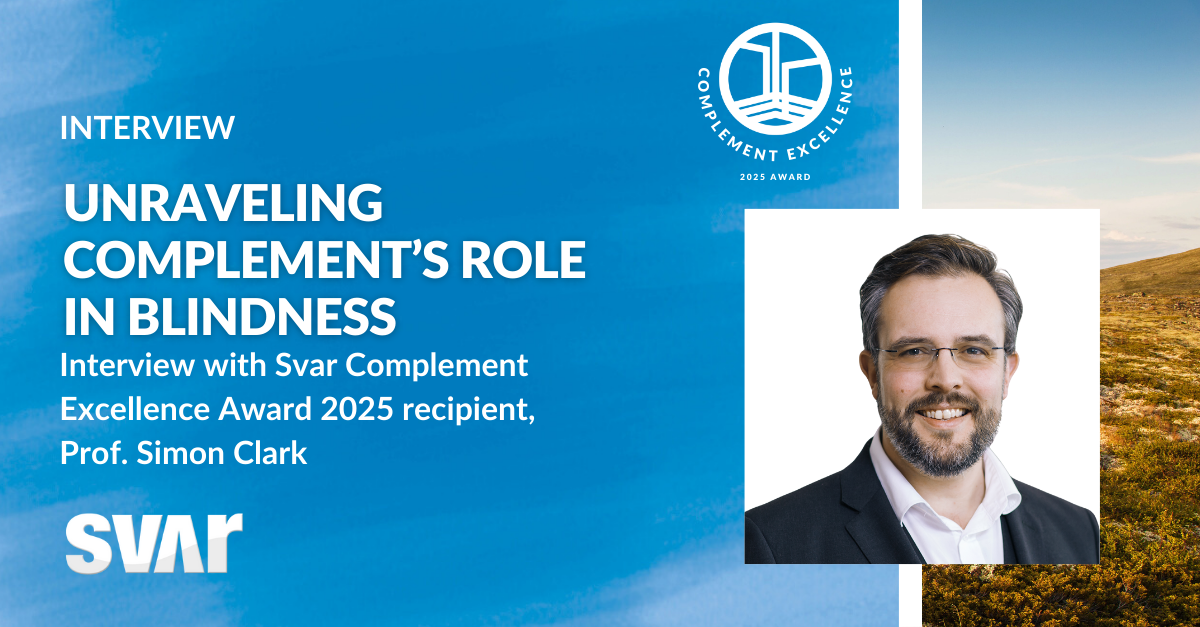

Unraveling Complement’s Role in Blindness: The Work of Professor Simon Clark
An interview with Svar Complement Excellence Award recipient 2025.
When Professor Simon Clark picked up a truncated piece of complement factor H (FH) in his Oxford lab years ago, he was simply doing biochemistry. He had no idea that protein fragment would end up connecting to one of the world’s leading causes of blindness.
At the time, he was working on what was once considered “a boring, rather dry subject”: FH and its interaction with glycosaminoglycans in the extracellular matrix (ECM).
Then, in 2005, a genetic polymorphism in that very protein was linked to age-related macular degeneration (AMD). Suddenly, Prof. Clark, who describes himself as “a protein biochemist by training, immunologist by trade,” found himself uniquely positioned to explain why this genetic variant mattered.
“I had in my hand a truncated part of factor H where the polymorphism existed,” he explained. “Only one year after the initial discovery, I was the first person to publish a paper explaining the biochemical consequences of this polymorphism. That’s where it all kicked off—in a disease I had never heard of before, in a field I had no interest in.”
This September, Prof. Clark received the Svar Complement Excellence Award at the International Complement Workshop in Brisbane for his contributions to understanding complement regulation in ocular disease. The award honored his discoveries in complement regulation while providing support for his lab’s ongoing efforts to develop new therapeutic strategies for AMD and related conditions.
A Career-Defining Discovery
Prof. Clark’s pivotal contribution reshaped how we understand immune regulation in the eye. He was the first to demonstrate how FH binds to sugar molecules in the ECM, a mechanism that helps the immune system distinguish self from non-self acellular structures. This wasn’t just elegant biochemistry; it was the foundation for understanding tissue-specific complement control.
Thinking back to those early days after his discovery, Prof. Clark said, “After my PhD I moved to Manchester and started hanging out with the ophthalmologists and got really, really into ocular immunity.”
The clinical implications became clear when Prof. Clark identified that the common 402H genetic variant disrupts this protective binding. Without FH properly anchored to the ECM, inflammation spirals out of control, leading to the retinal damage characteristic of AMD.
But the story grew more complex. Prof. Clark’s work revealed that a truncated form of FH, called factor H-like protein 1 (FHL-1), was the predominant complement regulator in the outer blood/retinal barrier, and that blood-borne factor H-related proteins (FHRs) compete with FHL-1 for the same binding sites in ECM-rich tissues like the retina. This molecular competition adds another layer of dysregulation—and another potential therapeutic target.
Building Infrastructure for Discovery
Prof. Clark’s impact extends far beyond the bench. Recognizing that animal models couldn’t replicate the complexity of human retinal disease, he co-founded the Eye Tissue Repository in Manchester, transforming discarded transplant tissue into one of Europe’s largest academic resources for ocular research.
When he moved to the University of Tübingen in 2019 to take up the Helmut Ecker Endowed Professorship of AMD, he brought the repository with him, where it was reestablished as the Helmut Ecker Eye Tissue Resource (HEETR). The logistics were surprisingly complex.
“It turns out there’s not a specific form for a professor turning up with 1,500 people’s eyeballs in the back of a truck,” he joked. “They didn’t know what to do.”
Today, the HEETR continues to enable discoveries impossible with animal models alone, fundamentally shaping how pharmaceutical companies develop complement-targeted therapies for the eye.
Bridging Bench, Bedside, and Biotech
In 2021, Prof. Clark co-founded Complement Therapeutics, a company developing complement modifiers for inflammatory diseases. It’s a natural extension of his research philosophy: understand the fundamental biology, then translate it into treatments.
Now leading both basic and translational research programs at Europe’s largest ophthalmic research institute, Prof. Clark’s lab is pioneering the use of retinal organoids to model complement dysregulation in AMD. These next-generation disease models offer unprecedented opportunities to study disease mechanisms and test therapeutic approaches in human tissue.
“This award will actively feed into AMD retinal organoid research and the development of next-generation modeling systems. It’ll go a long way to help people out.”
A Connection to Svar’s Legacy
The link between Prof. Clark and Svar runs deeper than this award. During his PhD at Oxford, he worked under Bob Sim, one of the original developers of the complement assays that would evolve into the Svar WIESLAB® assays.
“We use the WIESLAB assays extensively, and we’re looking to use some of the new cell-based reporter gene assays in the future,” Prof. Clark noted.
The funding from the Svar Complement Excellence Award will directly support his ongoing work. “This award will actively feed into AMD retinal organoid research and the development of next-generation modeling systems,” Prof. Clark explains. “It’ll go a long way to help people out.”
The Journey Continues
Looking back on his unlikely entry into ocular immunology and the two decades since, Prof. Clark shows no signs of slowing down. “If I was bored,” he reflects, “then I’d definitely be doing something wrong.”
Twenty years have passed since Prof. Clark was studying what he described as “a boring, dry subject” with no obvious clinical relevance. Today, his lab is pioneering retinal organoid models, his tissue resource enables therapeutic development across the industry, and the mechanisms he’s uncovered are driving drug development. The field he accidentally entered has become one he’s helping to lead.
For someone who stumbled into a field he’d never heard of, Prof. Clark has made himself remarkably hard to ignore. It’s the kind of career that emerges not from grand planning, but from serendipity meeting preparation. Sometimes the most important scientific breakthroughs come from the most unexpected places. For the millions at risk of vision loss from AMD, that accidental convergence of expertise and opportunity may well prove sight-saving.
Read more about Dr. Clark’s work:
Selected References
Clark, S.J., Schmidt, C.Q., White, A.M., Hakobyan, S., Morgan, B.P. and Bishop, P.N. (2014) Identification of factor H-like protein 1 as the predominant complement regulator on Bruch’s membrane: implications for age-related macular degeneration. J. Immunol. 193, 4962-4970.
Cipriani, V., Lores-Motta, L., He, F., Fathalla, D., Tilakaratna, V., McHarg, S., Bayatti, N., Acar, I.E., Hoyng, C.B., Fauser, S., Moore, A.T., Yates, J.R.W., International Age-related Macular Degeneration Genomics Consortium (IAMDGC), Morgan, B.P., de Jong, E.K., den Hollander, A.I., Bishop, P.N and Clark, S.J. (2020) Factor H-related protein 4 drives complement activation in age-related macular degeneration. Nature Comm. 11, 778.
Cipriani, V., Tierney, A., Griffiths, J.R., Sergouniotis, P.I., Zuber, V., Yates, J.R.W., Moore, A.T., Bishop, P.N., Clark, S.J.* and Unwin, R.D.* (2021) Beyond Factor H: the influence of genetic variation with age-related macular degeneration on circulating Factor H-like 1 and Factor H-related protein levels. Am. J. Hum. Genet. 108, 1-16.
About the Prize
The Svar Complement Excellence Award is handed out annually to individuals that have made great contributions to the complement field.
The awards are intended as grants for two recipients, each worth €20.000. In 2025 the prize was handed out during the 30th International Complement Workshop in Brisbane, Australia.