






As the pursuit of safer and more effective medical devices and extracorporeal systems continues, ensuring their biocompatibility remains a paramount concern. Central to achieving this goal is understanding the complement response, a crucial component of the body’s immune defence system.
Invizius is a biotechnology company that focuses on developing second-generation therapies for various complement-driven autoimmune and inflammatory disorders. The company focuses on identifying and characterizing the complement response that may occur during extracorporeal treatments. Their work is to establish a foundation for exploring H-Guard® priming solutions for use in setting up blood tubing sets and dialyzers before using them in dialysis, with the objective of limiting the patient’s complement response and thereby improving patient outcomes.
In this article, experts Dr. Andy Herbert, Co-Founder and CTO, and Dr. Elizabeth Blackburn, Principal Scientist at Invizius, share how their research contributes to tackling biocompatibility challenges in extracorporeal systems and how immunoassays play a critical role in generating reproducible and robust data.
Complement Response to Extracorporeal Systems
During extracorporeal treatments such as dialysis, the interaction between the patient’s bloodstream and foreign surfaces triggers immune responses in most individuals. Despite advancements in materials science aimed at reducing complications, patients undergoing extracorporeal treatments remain exposed to foreign materials over prolonged periods. When dysregulated, these responses can lead to complications, including inflammation, thrombosis, or tissue damage and poor patient prognosis. Chronic inflammation is well known risk factor for Cardiovascular disease (CVD), the most common cause of death in haemodialysis (HD) patients.
Monitoring the immunogenicity of medical devices employed in extracorporeal treatments, such as catheters, filters, and monitoring systems, is integral to ensuring these procedures’ efficacy and safety. These devices come into direct contact with the patient’s blood and tissues, making their biocompatibility paramount to prevent adverse reactions. For instance, vascular access devices like catheters must be made from materials that minimize thrombogenicity and inflammation while maintaining structural integrity and functionality. Similarly, filters used in extracorporeal circuits must effectively remove toxins and waste products from the blood without causing hemolysis or activating complement pathways.
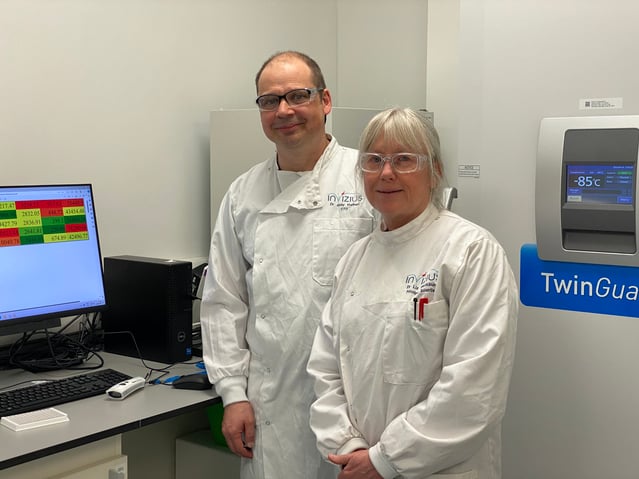 Dr. Andy Herbert, Co-Founder & CTO, and Dr. Elizabeth Blackburn, Principal Scientist at Invizius
Regulatory bodies worldwide increasingly recognize the importance of complement measurement in ensuring the safety and efficacy of medical devices. Guidelines such as ISO 10993 provide standards for the biological evaluation of extracorporeal circuits and medical devices, emphasizing the need for comprehensive biocompatibility assessments, including the evaluation of complement activation.
By integrating complement measurement into these standards, regulators aim to enhance the predictability and reliability of biocompatibility testing, ultimately safeguarding patient welfare.
“Broadly, we are measuring and analyzing the response that occurs when a patient’s blood comes in contact with extracorporeal circuits during a dialysis session. In the study led by Dr. Liz Blackburn, blood samples are taken at different time points during the dialysis session to observe what happens to the complement and inflammatory biomarkers,”
Dr. Andy Herbert, Co-Founder & CTO, Invizius
Assessing Complement Activation Dynamics: Identifying the Inflammatory Fingerprint
Invizius’s initial observational study (CompAct HD) focuses on hemodialysis patients. This patient population undergoes regular and intensive monitoring during each dialysis session, providing an ideal setting for studying complement dynamics. As explained by Dr. Herbert, measuring complement activation during hemodialysis is important to identify patients who are most likely to benefit from therapies that modulate the complement response.
“The CompAct HD study has given us a large amount of extra insights into the disease process and the patient’s potential outcomes. We can better understand which patients may need extra care and who is more likely to tolerate the dialysis procedure.”
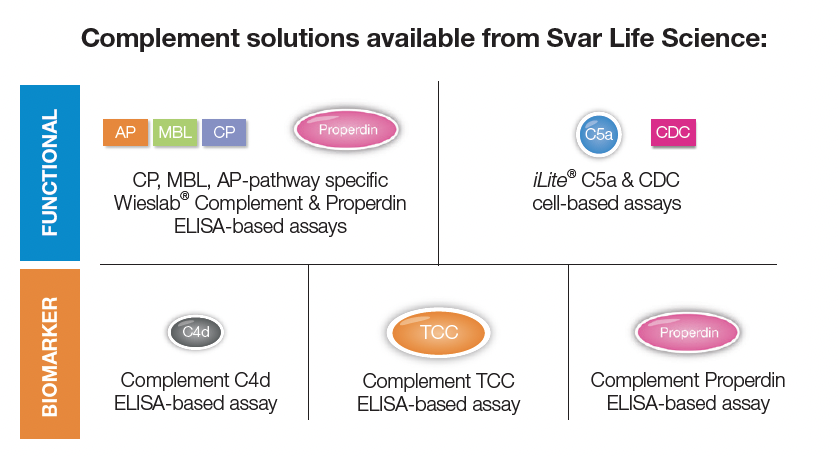
Assessing the individual activity of each complement pathway and levels of soluble C5b-9, also known as terminal complement complex (TCC), the team has aimed to provide a fingerprint of the inflammatory status of the participants. “In the CompAct HD study, we have assessed the innate complement ability at that particular point in time, using the Svar kits to look at the individual pathways. Throughout the dialysis session, we’ve looked at the formation of soluble C5b-9 using the Svar TCC assay,” mentions Dr. Blackburn. “Currently, our study comprises approximately 450 time course datasets from haemodialysis patients.”
The team has also measured other complement markers and cytokines to correlate the individual pathways with the different levels of the various proteins and inflammatory markers. “Starting our investigation in stable hemodialysis patients allows us to select patients that would benefit from modulating complement activation. Additionally, it provides a solid foundation for comparison of biomarkers during a standard extracorporeal treatment and when the system has been coated with H-Guard® priming solution. Currently, our study comprises approximately 450 time course datasets from haemodialysis patients,” explains Dr. Blackburn.
Differential Activation of Complement Pathways in Dialysis Patients
The research has revealed differences in complement activation between dialysis patients and healthy donors, shedding light on potential avenues for intervention by Invizius’ complement modulating strategies. Observing quite markedly different distributions of the complement activity for each pathway. Dr. Herbert notes, “The dialysis patient cohort has an unusual complement profile as they are over-represented at the extremes of the spectrum, and the normal range is underrepresented.”
To ensure the validity of their findings, the team began by comparing their baseline data for healthy donors to that previously reported by Svar during the standardization of the immunoassay, which revealed that the values were highly similar and reproducible across different settings.
“We compared the data from our cohort of healthy donors with that previously published by Svar; the high conformity between datasets gives us a high level of confidence in the results we’ve recorded and that the observed differences found in the dialysis patient groups are genuine.”
It is crucial to discern the root cause of the observed effects to provide tailored treatment to dialysis patients, whether it is a consequence of the disease itself, the treatment, or the patient’s complosome, which is the complex of complement proteins interacting with one another. Furthermore, the treatments administered could activate or deplete not only complement proteins but other proteins as well. “We need to remember it is not a homogeneous group, as there exist various reasons why they have developed end-stage kidney failure, so it is essential to comprehend the underlying causes to deliver individualized treatment to each patient,” notes Dr. Blackburn.
Biomarker Assessment for a Snapshot of Complement Activation
The activation of complement and the production of pro-inflammatory cytokines has been observed during dialysis sessions. The implication of this is that the dialysis session itself is causing it.
“We can detect biomarkers indicative of complement activation, including soluble C5b-9 (TCC), within 10 minutes of initiating a session, which is fascinating.”
Dr. Elizabeth Blackburn, Principal Scientist, Invizius
Since complement activation can occur as a result of improper sample processing methods, this marker also can serve as a reliable indicator of the efficacy of sample handling. To validate their results, Invizius’ team compared samples taken before the dialysis session to samples from healthy donors processed using the same methods; in both cases, they found that complement activation levels were consistently below the detection limit, supporting proper sample handling techniques and the absence of unintentional complement activation.
These findings underscore the relevance of biomarker assessment to provide a snapshot of complement activation during dialysis sessions, which has implications for developing effective therapeutic interventions.
Overcoming Challenges During Complement Assessment
Assessing complement biomarkers poses several challenges that require careful consideration. Dr. Herbert points out that the issues of variability and sample handling arise irrespective of the method used to measure complement.
“Svar kits have been beneficial for their standardized nature, which enables the isolated assessment of individual pathways effectively. This means that there is no need to use other activation assays or hemolysis-type assays, making the process more straightforward.”
Dr. Andy Herbert
Dr. Blackburn mentions that meticulously handling the samples, including strict time and temperature conditions for serum samples, centrifugation speeds, freezing methods, and shipping procedures, to minimize the impact of sample handling on the study and maximize the data’s signal-to-noise ratio, is required to ensure consistency across their assessment. “We have set up an automated liquid handling system that will allow for the consistent execution of various tests. The system includes liquid handlers, a plate washer, an incubation system, readers, and a robotic arm that ensures consistent transfer times between individual plates.” Additionally, being able to analyze three different pathways using the same serum sample has also positively impacted consistency.
“We can look at three complement pathways with one sample; it means we have a lot more blood to go around. You can repeat your assay and have more replicates. It just gives us much more room to get robust data.”
Dr. Elizabeth Blackburn
The strategy adopted by the team, stratifying the distribution of patients into quartiles and deciles, together with their strict sample handling, provided them with a valuable perspective. Exploring the impacts of activation of the alternative pathway on various cytokines in a more nuanced and insightful manner, as explained by Dr. Herbert. “By categorizing patients into different segments of the normal distribution, we could more effectively identify and analyze the implications on other inflammatory biomarkers of the intrinsic ability of alternative pathway activity. This approach enhanced our understanding of the relationship between the alternative pathway and inflammatory biomarkers. It steered our research in a more meaningful direction, opening up new avenues for investigation and intervention.”
Developing the Next Generation of Complement Inhibitors: The Quest for Local Inhibition
The CompAct HD study has facilitated the identification of patients who can benefit from using Invizius’ H-Guard® priming solution. As Dr. Herbert explains, H-Guard® is a novel method of inhibiting complement activation. It involves priming the dialysis equipment with the priming solution, which, upon coming into contact with the patient’s blood, binds to the patient’s own Factor H, thereby coating the entire dialysis circuit in this important complement regulator. Additionally, the binding process results in a natural change in the conformation of Factor H, which increases its effectiveness as a complement regulator up to five times. This mechanism is specifically designed to treat complement activation locally, leading to a quick dampening of the response while retaining the normal complement function in the body. “The H-Guard® mechanism is unique, as it coats everything and makes it much more invisible to the immune system,” mentions Dr. Herbert.
Impact of the Complement System in Medical Device Applications
As described, the complement system plays a paramount role in various diseases, disorders, and treatments. It is imperative to understand the intricacies of how the patients’ complement systems react to different illnesses, lifestyle factors, and treatments. “It is important to understand how the complement system of patients reacts and how all of these factors are intrinsically related. If we can achieve this, it would benefit the community to understand the distribution of complement activation in different diseases and treatments that patients undergo. This is not just limited to adding to our knowledge of diseases, but also to improving our understanding of the patients and their overall health.” says Dr. Herbert
The first in-patient safety study of H-Guard® is currently finalising and has used the measurement of markers of complement activation and inflammation comparing the results of a baseline session with a session where the circuit was primed with H-Guard® , and a follow-up session. The positive results obtained during the ‘first in patient’ study are allowing us to design our next phase 2 interventional study that aims to focus on the effectiveness of H-Guard® . “This interventional study will enable us to measure H-Guard’s effectiveness. Furthermore, it will help determine which immune pathways were actually activated by a dialysis session, the level of H-Guard’s treatment effect, and hopefully we may see improvements in patient outcomes” notes Dr. Herbert.
Invizius’ work has the potential to greatly benefit patients undergoing all forms of hemodialysis. By investigating complement biomarkers in blood during dialysis, they aim to demonstrate the mechanisms by which complement activation during dialysis elevates the inflammatory state of dialysis patients. They further aim to mitigate this effect by introducing H-Guard® priming solution, which is designed to suppress complement activation, and can potentially enhance the safety of dialysis treatment and reducing the risk of complications caused by complement activation. Together, these advancements could lead to greatly improved patient outcomes, improving the quality of life and overall well-being of patients who require extracorporeal circuits.