





Article originally published by SelectScience (selectscience.net)
In the article, Dr. Marie-Agnès Dragon-Durey, Associate Professor in Immunology at the Université de Paris, explains more about the role of the complement system in viral infectious diseases, such as COVID-19.
With over 20 years of experience improving diagnostics for autoimmune diseases and exploring the complement system, Dragon-Durey’s current research focuses on the use of biomarker assays to determine whether deficiencies, overactivation, or dysregulation in the complement system are causing or contributing to a person’s disease or condition. Dragon-Durey has carried out work on the C4d protein using biomarker assays produced by Svar Life Science.
 The complement system is an important part of the innate immune response and plays a key role in the defence against invading pathogens, including viruses, bacteria, fungi, and parasites.
Recent studies have shown that complement overactivation plays a critical role in the pathogenesis of COVID-19 and other viral diseases, suggesting its huge potential as a biomarker for infectious diseases. Being able to accurately measure how, where, and why the complement system is activated is essential for the diagnosis and development of treatment for infectious diseases, as well as a wide range of other disorders where the complement system is involved.
The Role of Complement C4d in Infectious Diseases
Biomarkers have become indispensable tools in the detection, diagnosis, and treatment of SARS-CoV-2 as they provide an objective and quantifiable measurement of COVID-19 progression. The emergence of new biomarkers for SARS-CoV-2 continues to be an area of interest as scientists strive to improve the accuracy of COVID-19 diagnostics. During the recent pandemic, complement activation was very quickly shown to participate in the innate immune response induced by SARS-CoV-2 infection, and complement biomarkers were used to follow the activity of the disease. However, it has not yet been established if this activation is the cause of the hyperinflammatory syndrome associated with severe forms of the disease.
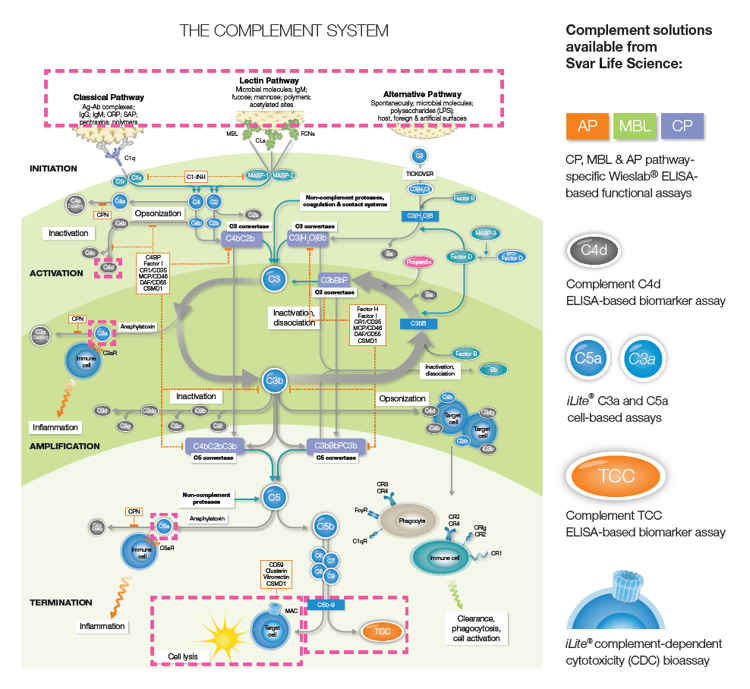
Ongoing research in this area has highlighted promising components. The first being complement C4d protein, a fragment of the complement component C4, produced after cleavage of C4b by the regulatory protein Factor I. This is a relatively new plasmatic
biomarker and, while it has been used to diagnose classical pathway activation in tissue - notably in grafted organs reflecting humoral rejection - for several years, its applications are still being explored.
“The C4d protein has shown potential in the fields of autoimmunity - for the prediction of active disease in lupus - and oncology - for the prediction of bad prognosis in renal and lung cancer,” Dr. Dragon-Durey notes. “In the context of COVID-19, C4d may also be a reliable biomarker to decipher the complement functions during the different phases
of the infection."
Dragon-Durey’s research involves measuring potential biomarkers like these to better characterize COVID-19 and the specific pathways to be targeted. Through this work she has seen that the complement system plays a key role in the disease’s pathogenesis.
“We have monitored patients suffering from severe COVID-19 by measuring cytokine levels, lymphocyte phenotyping, and complement exploration,” explains Dragon-Durey. “Originally, innate immune cells were lacking from our panel despite granulocytes being key players in the disease progression, but by measuring plasma calprotectin and C4d we have bridged this gap between innate immune cells and complement activation.”
The Analytical Challenges of Using Biomarkers to Determine Disease Pathology
At the Assistance Publique Hôpitaux de Paris, Dragon-Durey works with fellow researcher Dr. Véronique Frémeaux-Bacchi, performing a variety of assays necessary for the characterization of complement deficiencies due to acquired causes - systemic consumption or presence of autoantibodies - or genetic abnormalities.
"In the field of complement exploration, it is important to combine different assays to try to discriminate a quantitative deficiency, a qualitative deficiency, or a protein consumption due to complement activation,” Dragon-Durey shares. “As a result, there are often different analytical challenges to manage.”
It is important to inactivate the complement cascade so that auto-activation does not occur in the test tubes. This can be accomplished by collecting in tubes that contain compounds
such as EDTA that will inactivate the cascade reaction. A thorough understanding of how the sample is affected and how to preserve it is necessary to obtain trustworthy results.
The Future of Biomarker Research
The development of new SARS-CoV-2 biomarkers requires multiple areas of expertise and a large amount of collaboration. With regard to the use of complement in drug development
towards infectious disease, Dragon-Durey believes that there is still more work to be done. “Different molecules targeting the complement system are currently tested in different trials in the context of SARS-CoV-2 infection,” explains Dragon-Durey. “However, their place in the therapeutic strategy still needs to be determined, and this could be achieved with the help of specific complement biomarkers.”
Dragon-Durey is optimistic that with continued research and a focus on interpreting the data provided by new biomarkers according to the analytical context and the clinical situation, they will soon be at the forefront of immune exploration. “This will allow us to determine their real value and their place in the monitoring of immune diseases among other biological biomarkers,” concludes Dragon-Durey. “If we can take their measurements more easily, it would allow them to be placed at the first line of immune exploration.”