Understanding what role potency testing plays at every stage can help you design a strategy that will stand the test of product development, regulatory scrutiny, and lifecycle management.

Does the drug do what it’s designed to do?
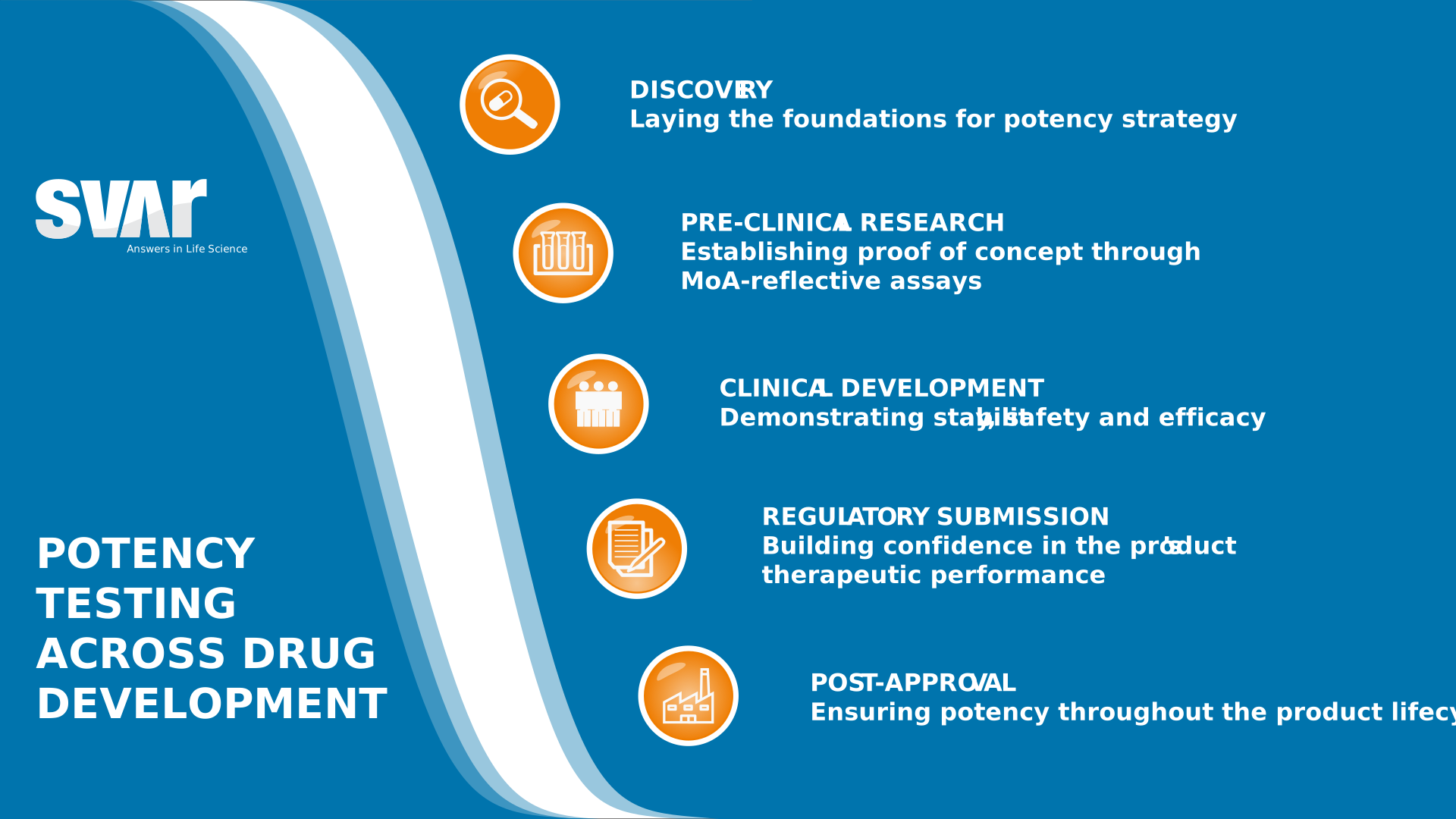
A stage-by-stage guide to potency strategy in biologics development
Potency testing is a cornerstone of biologics development, serving as a critical quality attribute that links a product’s mechanism of action to its intended therapeutic effect. It provides a quantitative measure of a drug’s biological activity and ensures that it performs its intended function consistently and safely. In this article, we will explore the role potency testing plays in each stage of a biological treatment's development and lifecycle.
Potency evidence forms is a key part of the evidence that regulatory bodies require when evaluating market authorization, as indicated by the international specifications for biotechnological and biological products (ICH Q6B).
But its role goes far beyond simply being a regulatory requirement. Through potency assays, developers generate the biologically relevant data needed to inform strategic decisions across the product lifecycle – from candidate selection and process development to manufacturing and quality control and subsequent commercialization.
As biologics and advanced therapeutic modalities grow increasingly sophisticated and complex, potency testing strategies and technologies must evolve in parallel. Assays must be scientifically relevant, fit for purpose, and capable of supporting both product development and regulatory requirements throughout the product lifecycle.
To meet these demands, developers are increasingly turning to function-reflective approaches, such as cell-based assays, that measure biological activity in biological relevant systems. These advanced methods provide a more comprehensive understanding of therapeutic function and offer deeper insights into a product’s clinical potential.
Why is potency testing different in biologics?
Biologic therapies are revolutionizing medicine and helping to develop innovative treatment that address unmet medical needs. Biologics are medicines derived from living organisms or produced using biotechnology that target specific molecular pathways to elicit a desired therapeutic effect. Biologics are designed to act on particular biological structures and functions (molecules, cells, or receptors) involved in disease processes. This makes them particularly valuable treatment options for autoimmune diseases, inflammatory disorders, cancers, genetic disorders and more. Major types of biologic therapies include engineered antibodies, recombinant proteins, vaccines, and advanced therapies including cell and gene therapies.
As biologics and advanced therapeutic modalities grow increasingly sophisticated and complex, potency testing strategies and technologies must evolve in parallel. Assays must be scientifically relevant, fit for purpose, and capable of supporting both product development and regulatory requirements throughout the product lifecycle.
To meet these demands, developers are increasingly turning to function-reflective approaches, such as cell-based assays, that measure biological activity in biological relevant systems. These advanced methods provide a more comprehensive understanding of therapeutic function and offer deeper insights into a product’s clinical potential.
How to develop a successful potency strategy
A successful potency strategy for biologics starts with selecting the right assay approach as early as possible in development. Early assay design helps build a deep understanding of the therapeutic candidate’s mechanism of action (MoA), establish reproducibility, and generate the data needed to guide product and process decisions.
Choosing robust and scalable assays that can be qualified, validated and transfered later creates a consistent framework for monitoring biological activity throughout development and manufacturing. Ultimately, defining the potency testing early in the discovery and development process helps lay the foundation for efficient development, long-term quality control, and a smoother path to regulatory approval.
By understanding the role potency testing plays throughout and beyond drug development, you can better identify and design the right strategy for your development program, ensuring that the evidence built can stand the test of product development, regulatory scrutiny, and lifecycle management.
Discovery
In brief:
-
Identify the most promising candidates based on their MoA.
-
Link biological activity to therapeutic potential.
-
Build early evidence to support future development decisions.
-
Create a consistent potency strategy across the product lifecycle.
-
Reduce the need for major assay changes later in development.
The discovery phase is all about finding the most promising drug candidate to advance to later stages of development. Establishing an appropriate potency testing strategy already at this stage helps define the relationship between a candidate’s MoA and its intended therapeutic effect and lays the groundwork for a comprehensive data package of the candidate’s biological activity.
A major objective at this stage is selecting an assay approach that is sufficiently predictive of the product’s biological function while remaining adaptable to future qualification and validation requirements. Choosing a potency assay approach that accurately reflects the candidate's MoA helps ensure a cohesive strategy throughout development. Maintaining that continuity minimizes the likelihood that assay redesign, additional validation work, or costly bridging studies will be required later in the program, and provides a stronger foundation for regulatory submissions.
Several assay approaches can be used during discovery. Surrogate methods, such as enzyme-binding assays, offer simplicity, speed and cost efficiency, making them valuable screening tools. However, because they typically measure only a single biological interaction, they may not fully capture the complexity of a product’s biological activity.
In contrast, functional bioassays like cell-based systems more directly correlate the candidate’s MoA with the desired therapeutic effect. While bioassays intrinsically have higher variability and costs, they are more likely to support qualification, validation and regulatory acceptance in later stages, facilitating smoother progression from discovery through clinical development and commercialization.
Start with the right strategy. Build robust evidence. Maintain confidence throughout development, regulatory approval, and lifecycle management.
Pre-clinical research
In brief:
-
Demonstrate proof of concept through MoA-reflective assays.
-
Build an understanding of product biology.
-
Establish analytical foundation for CMC activities.
-
Identify key factors influencing product quality and performance.
-
Streamline technology transfer across teams and external partners.
During pre-clinical studies it is crucial to balance speed with long-term scalability by employing a potency strategy that can support rapid decision-making today while remaining suitable for later-stage development and commercialization. At this point, potency assays are primarily used to demonstrate proof of concept by confirming that a therapeutic candidate exhibits the intended biological activity.
As the program evolves and testing strategies crystallize, potency testing builds on the evidence generated during discovery, providing deeper insights into product biology and supporting characterization and safety and efficacy assessments. The resulting data helps strengthen understanding of the candidate while informing key development decisions.
Potency assessment also begins to play an increasingly important role in establishing the analytical foundation for Chemistry, Manufacturing and Controls (CMC). By generating reliable measures of biological activity, potency assays help support the transition from exploratory research to the development of a scalable, controlled, and regulatory-compliant product.
To ensure continuity throughout development, potency assays should be selected with future qualification, validation, and technology transfer requirements in mind. Choosing robust, scalable, and transferable methods early can facilitate smoother progression through subsequent phases, support interactions with external partners and quality-control laboratories, and reduce the risk of delays associated with assay changes later in development.
Clinical development
In brief:
-
Demonstrate therapeutic performance, stability, safety and efficacy.
-
Ensure consistent potency across clinical batches.
-
Support comparability assessments and lot release testing.
-
Qualify assays and reference standards for reliable testing.
-
Strengthen and complete the regulatory data package.
Clinical development represents the critical test in a therapeutic product’s development, as it is at this stage that safety and efficacy are evaluated in human subjects. Understandably, as the programs advance into the clinics, regulatory requirements for potency assays become much more defined and stringent, reflecting the growing importance of consistent product performance and quality.
At this stage, potency assays play a central role in generating the evidence needed to support market authorization. In addition to confirming therapeutic activity, they help demonstrate product safety, efficacy, stability, and consistency throughout development. Potency testing also becomes essential for establishing comparability between batches and ensuring a product is suitable for lot release and large-scale manufacturing.
As assays transition from development tools to regulatory-critical methods, validation requirements become more rigorous. While phase-appropriate validation requirements during discovery and early development are more permissive, clinical development requires fully validated and well-characterized assays. Ultimately, validated potency assays provide evidence that a product's biological activity remains consistent over time and that its mechanism of action, stability, and quality meets the standards required for commercialization.
Regulatory filing
- Build confidence in the product’s safety, efficacy and therapeutic performance.
- Confirm batch-to-batch consistency and product quality.
- Demonstrate comparability following process changes.
- Ensure that the product remains consistent.
- Support lot release and product stability.
Regulatory submission is the moment of truth and the culmination of years of development, where the generated body of evidence is put under the severe scrutiny of regulatory bodies.
Potency data become a central component of the regulatory package, forming a comprehensive picture of the therapeutic product performance and clinical relevance rooted in a clear link between the therapeutic MoA and the observed clinical benefits.
Potency testing plays a critical role in building confidence that the product consistently delivers the biological function underlying its intended clinical benefit. These data support key elements of the Chemistry, Manufacturing and Controls (CMC) section, helping justify product specifications, release criteria, and manufacturing controls. Potency evidence is also used to demonstrate comparability across changes in manufacturing, formulation, process or site, while confirming that all batches consistently meet predefined quality standards and deliver comparable biological activity.
In addition, potency assays support lot release and stability programs by providing validated methods to monitor a product’s performance throughout its shelf life. Together, these data demonstrate that the commercial product remains consistent with the one evaluated during development and clinical testing.
Because potency testing sits at the intersection of product quality, manufacturing consistency, and clinical relevance, it is often a focal point of regulatory review. Insufficient or poorly justified potency data can lead to regulatory questions, approval delays, or even failure to obtain marketing authorization. Conversely, a robust potency data package strengthens confidence in the product's safety, efficacy, and quality, making it a cornerstone of successful regulatory approval and lifecycle management.

Post approval
In brief:
-
Verify that each lot meets predefined release specifications.
-
Monitor product stability and biological activity throughout shelf life.
-
Confirm batch-to-batch consistency and product quality.
-
Demonstrate comparability following production changes.
-
Provide analytical support for post-approval changes.
Potency remains essential long after a product receives marketing authorization. Once the product is commercially available, the focus of potency testing shifts from proving that a therapy works to ensuring that every batch continues to perform as intended throughout a product’s entire commercial lifecycle.
As production scales up, potency helps ensure that the product remains comparable regardless of changes in process, equipment, scale, formulation, raw materials or manufacturing site.
Manufacturers also use potency measures to ensure that each lot meets predefined acceptance criteria and that manufacturing processes continue to produce products with the same biological activity observed during development and clinical testing.
Potency therefore becomes a necessary tool for monitoring the product’s stability, and to demonstrate the that the safety, efficacy, and quality profile established during clinical development is retained throughout the product’s shelf life.
Beyond routine quality control, potency testing plays a central role in lifecycle management. It provides the analytical foundation needed to support manufacturing optimization, process improvements, post-approval changes, and production expansion, enabling companies to maintain consistent product quality while meeting evolving commercial and regulatory requirements.
How Svar supports you
At Svar Life Science, we support biopharma companies by translating complex biology into robust, regulatory-ready assay solutions that help you navigate the evolving complexities of modern biologic therapeutics.
We know that the path of innovative life-changing treatments starts in the lab, years before they reach the patients, with future-proofed testing strategies and robust evidence that build confidence throughout the development continuum.
Robust and scalable potency assays help you create a consistent framework for generating the data needed to guide product and process decisions and lay the foundation for efficient development, long-term quality control and a smoother path to regulatory approval.
Download our stage-by-stage guide
FAQ
What is potency testing?
Potency testing measures the biological activity of a drug and determines whether it produces its intended biological effect. Potency is considered a critical quality attribute because it demonstrates that a therapeutic product performs as expected.
Why is potency testing important in drug development?
Potency testing helps ensure that a therapeutic product is safe, effective, and consistent throughout development and manufacturing. It is used to confirm that the product maintains its biological function over time.
What does a potency assay measure?
A potency assay measures a biological response that is directly related to a product's mechanism of action. Depending on the therapy, this may include receptor activation, cell signaling, cytokine production, cell proliferation, or other functional endpoints.
What is the difference between potency and efficacy?
Potency describes the strength of biological activity under defined conditions, while efficacy refers to the maximum effect a therapy can achieve. Potency measures how much activity a product has, whereas efficacy describes the extent of the therapeutic response.
When is potency testing performed during drug development?
Potency testing is performed throughout the drug development lifecycle, including early discovery, preclinical studies, clinical development, process development, manufacturing, and product release testing.
What types of assays are used for potency testing?
Potency can be measured using cell-based assays, reporter gene assays, binding assays, enzymatic assays, and other functional methods. The most appropriate assay depends on the therapeutic product and its mechanism of action.
Why are potency assays important for gene and cell therapies?
For advanced therapies, potency assays help demonstrate that the product's intended biological function is maintained and can support development, manufacturing, and regulatory requirements.